

This year I wanted to elevate my Easter egg efforts.
Historically, I’ve only dyed eggs with fizzy tablets in vinegar, roughly sketching out my name ahead of time on the egg with a thick crayon. The process is nostalgic, bringing back many happy memories of dyeing eggs as a child, but my results are always a bit rudimentary.
I didn’t realize how elaborate Easter egg decorating could be until I befriended Ukrainian Catholics. My friends broadened my horizons by introducing me to the incredible art of pysanky, ornate eggs made by applying hot wax via a stylus in intricate patterns between progressively darker dye baths.
Of course, I wouldn’t attempt to make those mini masterpieces. My artistic abilities are decidedly limited.
But I wondered if there was an Easter egg decorating method I could manage that was in between the simplistic fizzy tabs and crayons and the lofty pysanky.
The Internet served up a plethora of decorating ideas, from colored shaving cream to nail polish on water.
I was looking for a less crafty method when I found instructions on how to create natural egg dyes by boiling chopped vegetables.
Perfect!
I could boil water with the best of them, so I knew this strategy might be doable even for someone with my “skill” set.
To create every color of the rainbow, the site recommended simmering two cups of the following with two cups of water each — with the exception of turmeric, which should be one quarter cup — for 15 to 30 minutes: Beets, onion peels, turmeric, purple cabbage, and blueberries.
After simmering, the vegetables should be strained out and one tablespoon of white vinegar added to every cup of leftover liquid.
An overnight soak should yield vibrantly hued eggs.
I could do this, I thought.
Once I had gathered all of my items from previously unvisited corners of the produce section — I’d never touched a raw beet before — I got to work.
First, I needed to hard boil eggs.
From prior experience, I knew that 12 minutes of simmering would make the perfect hard boiled egg with a velvety yellow center.
When the time was up, I swiftly scooped up the eggs and placed them on paper towels to cool.
It wasn’t until later that I realized I’d only taken six of the eggs out of the water. I’d gotten distracted, leaving the other six in the hot water, which were sure to develop weird green yolks.
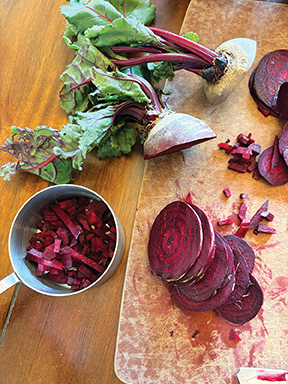
Next, I chopped two beets.
I marveled over their beautiful crimson interiors and felt gloriously connected to nature.
What a beautiful world God gave us!
After simmering the beets, I strained them, poured the boiling liquid directly into a measuring cup, then added the necessary vinegar because I had lots more colors to make before the day ended.
Also, my hands were impervious to scalding water after years of making corned beef and cabbage.
One color down, I paused my project to pick up a child at practice then stop at the store for turmeric.
I’d discovered that cumin was not an acceptable substitute. It’d looked like swamp water.
Back at home and with bedtime on the horizon, I moved through the final steps as quickly as I could.
I boiled the onion peels. It felt backward keeping the peels and throwing away the onions.
Then I made the turmeric solution, which colored everything, including my hands, a yellow ochre.
Surprisingly, the purple cabbage water turned a dark blue and the blueberry water was a deep purple.
I plunged an egg into each cup of liquid and refrigerated them overnight.
The next day, I examined the eggs.
The beet egg was a beautiful, slightly mottled maroon.
The onion egg was a gorgeous rust.
The turmeric egg was a bold gold with a faint band around the center marking where the sediment had settled in the cup.
The cabbage produced a lovely baby blue egg that turned aqua as it dried.
And the blueberries created an eggshell with the same dark blue with whitish cast of a blueberry.
The verdict?
The eggs were vibrant with natural variations that I felt didn’t even require extra decorating, and therefore any artistic ability, on my end.
So, a success!
The drawbacks were that this took ten times as long as the fizzy tablets and littered my kitchen with jars, pots, and veggie clippings.
But contemplating the beauty of our natural world — and by extension our God — was well worth the extra effort.
“The Earth is full of the steadfast love of the Lord.” -Psalm 33:5
Meg Matenaer is a wife, mom, social media writer, and author residing in the Diocese of Madison.