Skip to content
Catholic Herald flag

Madison Catholic Herald Archive (2001-2025)

Official newspaper of the Diocese of Madison, Wisconsin

  • News
    • Around the Diocese
    • State News
    • National-World
    • Obituaries
    • Older Editions
    • Diocese of Madison’s 75th anniversary
  • Bishop
    • Bishop Hying’s Columns
    • Bishop Hying’s Letters
    • Bishop’s Schedule
    • About Bishop Hying
    • About Bishop Morlino
    • About Bishop Bullock
  • Opinion
    • Editorial
    • Letters to the editor
    • Columns
    • Columns by name and author
  • Faith
    • Faith
    • Year of Faith
    • Faith Alive
  • Calendar
  • Obituaries
    • Clergy obituaries
    • Religious obituaries
    • Lay person obituaries
  • Multimedia
  • Advertising
    • Advertise with Us
      • Ad Policies
      • Ad Specifications
      • Classifieds Information
    • Rates & Specs (PDF)
    • Special Section Calendar (PDF)
  • About
    • About Us
    • Contact Us
    • Links
    • Catholic Herald Promotion Materials
    • Rates & Specs (PDF)
    • Subscriptions
  • Youth
  • Español
 
  • Home
  • News
  • Around the Diocese
  • Exploring the challenges and possibilities of AI
  • Around the Diocese
  • Front page
  • News

Exploring the challenges and possibilities of AI

On January 10, 2024January 8, 2024
Erin Daly
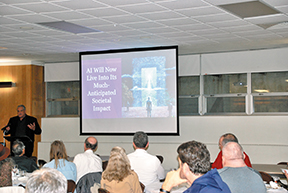
Dr. Timothy Carone speaks on “The Human Simulacrum: The Good, The Bad, and the Ugly of AI,” recently at Blessed Sacrament Parish in Madison. (Photo by Erin Daly)

The recent explosion of artificial intelligence (AI) has been met with mixed reactions, from optimism to alarm to confusion.

What exactly is AI? How is it being used? Are there legitimate and ethical uses for it that align with Catholic values?

Dr. Timothy Carone addressed these questions and more at a recent lecture called “The Human Simulacrum: The Good, The Bad, and the Ugly of AI,” given at Blessed Sacrament Parish in Madison.

Defining AI

Dr. Carone is a lecturer with the College of Business and Economics at the University of Wisconsin-Whitewater who teaches machine learning, cyber security, and information technology.

He is also Catholic, and his lecture dove into the opportunities and challenges that AI presents to the world and to the Church.

AI, Dr. Carone said, dates to the 1940s and 1950s when people “wanted machines to exhibit human-like intelligence behavior.”

That has been the goal since day one, and it seems like recent, popular systems of AI such as ChatGPT (GPT stands for “generative pre-trained transformer”) have achieved this; they are often used to generate content such as text, answers to questions, and images based on prompts that a user inputs.

These systems, said Dr. Carone, have advanced from simple predictive text formulas (in which it tries to “guess” the next word based on the word that comes before it) to generating output based on the context of the entire prompt.

This involves “pre-training” the system to recognize patterns in prompts.

Where problems arise

As helpful as AI tools can be, Dr. Carone pointed out that they are subject to bias depending on the sources of the data that AI uses to generate output.

To illustrate, Dr. Carone showed an image in his slideshow that was generated using AI; he asked a model to create the image using the words “bad AI,” and he pointed out that one of the human figures in the image looks a lot like Donald Trump.

He also prompted the model to create a “good AI” image, and it featured Barack Obama and Hillary Clinton.

What’s “good” and “bad” depends on who’s setting up the AI system.

Because of this vulnerability to bias, Dr. Carone expressed concern about AI accelerating social divisions and being used for sinister purposes.

“The danger of this sacralization of technology is that it takes on a role of a new secular religion,” said Dr. Carone.

“People depend on it. They want to use it because it gives them control over others and allows them to achieve the outcomes that they want. And the problem is, people don’t see this for what it is.”

“Societies can believe that we’re progressing in a good way beyond tyranny, when in fact, we’re moving directly into tyranny and not realizing it,” Dr. Carone continued. “So technology has to be subordinated to wisdom and virtue and not the other way around.”

A force for good

Still, Dr. Carone said that he sees himself as an optimist and believes that AI can be used for good.

At its best, he said, AI “showcases human innovation and creativity, mirrors human thought, illuminates the intricacies of our creation, and draws parallels with divine artistry.”

He also said that the Church shouldn’t hesitate to combat bad uses of AI by using the technology for good.

During a Q&A that followed his talk, Dr. Carone said that Catholic scientists should not be afraid to bring the Church’s moral wisdom into developing the “guardrails” that AI needs.

He also said that AI can be a powerful tool for evangelization and envisions a sort of “Catholic ChatGPT” that could be programmed to draw upon a variety of Catholic sources to answer questions about the Faith.

To view Dr. Carone’s talk, go to blsacrament.org/dominic-and-the-doctors.

Share this:

  • Share on Facebook (Opens in new window) Facebook
  • Share on X (Opens in new window) X
In Around the Diocese Front page NewsIn Artificial Intelligence (AI) , Blessed Sacrament , Dominic and the Doctors , Erin Daly

Post navigation

A lesson in Catholic hospitality
What’s new at Resurrection Cemetery in Madison?

This webite, madisoncatholicheraldarchive.org, covers Catholic Herald content from October 11, 2001 to September 18, 2008 (HTML-based website) and September 19, 2008 to October 8, 2025 (WordPress-based website).

To view content prior to 9/19/2008, browse our older editions (FreeFind site search no longer available).

To search content from 9/19/2008 to 10/8/2025, use the search box above.

For newer content, please visit madisoncatholicherald.org (FAITH Catholic-based website).

e-Edition:

click to go to the Catholic Herald e-Edition

Access our e-Edition here. For more information, contact the Catholic Herald office at 608-821-3070 or email: [email protected]

Most popular:

  • Your guide to our local fish fries
  • Chancellor William Yallaly accepts national position with the Knights of Columbus
  • Catholic Multicultural Center and St. Mary's partnership
  • Summer seminarian assignments
  • The best nuncio we’ve had thus far

Please support our advertisers:

  • Your ad could be here! Call (608) 821-3074

Bishop Hying’s videos:

'A Moment with the Bishop' videos on YouTube

Promote the Catholic Herald:

click for Catholic Herald promotion materials

Click here for information and materials to promote the Catholic Herald in your parish.

RSS feeds

RSS feed

You May Like

  • Around the Diocese
By Rachel Dietzman and Amy Lachuk, Catholic Charities of Madison
On September 26, 2019

Hope Haven prepares for new facility

  • Around the Diocese
Kevin Wondrash
On December 27, 2017

Additional workshop for extraordinary ministers of Communion

  • Around the Diocese
Kevin Wondrash
On January 13, 2016

Knights and Ladies of Divine Mercy evening of reflection

  • Around the Diocese
Kevin Wondrash
On March 26, 2015

Polish community keeps Easter traditions

  • Around the Diocese
  • Front page
  • News
Catholic Herald Staff
On October 4, 2023October 4, 2023

40 Days for Life underway in Madison

  • Around the Diocese
Kevin Wondrash, Catholic Herald Staff
On August 20, 2015

Bishop Morlino, pro-life leaders support ban of selling fetal body parts

  • Catholic Herald on Facebook

Copyright © 2001-2025 Diocese of Madison, Catholic Herald. All rights reserved.
Website created by Leemark.com and Catholic Herald staff using Telegram theme.